Stiesdal accelerates the development of SkyClean
with new test facility
Odense, 18 August 2021
PRESS RELEASE
Stiesdal Fuel Technologies has inaugurated the company’s first fully automatic SkyClean pyrolysis plant. The new plant is a test plant and is part of a planned phase in the scaling of the SkyClean technology. SkyClean is a pyrolysis process that both captures and stores CO₂ and produces green fuels.
The new plant was built by SmedTek, a small agriculture machine shop in Brædstrup, Denmark. The plant has a capacity of 200 kW and can treat 500 tons of agricultural waste annually, which gives a total CO₂ reduction of approximately 600 tons.
The test plant is an important part of the preparations for the ten times larger 2 MW SkyClean plant, which Stiesdal Fuel Technologies will start establishing at GreenLab in Skive later this autumn.
Henrik Stiesdal, CEO of Stiesdal A/S, says: “We are very happy to take the new plant into use. The plant is an important steppingstone for us in the development of the processes in SkyClean, and it has been a pleasure to see SmedTek build what is for them a completely new type of industrial plant in a very short time. The UN’s new climate report emphasises that speed matters. We know that SkyClean can provide both CO₂ reduction and jobs, and we know that it is urgent to get this type of climate solution on track if we are to avert the worst effects of global warming in time. SmedTek has delivered at the necessary speed, and we hope to be able to maintain the pace in the next steps towards commercialisation.”
Stiesdal Fuel Technologies has financed the new test facility, which so far is placed at SmedTek in Brædstrup. The company also finances the upcoming 2 MW SkyClean plant at GreenLab, which is expected to cost around DKK 20 million.
The preparation of the SkyClean technology towards actual commercialisation will continue in 2022, when another 2 MW pilot plant will be established with a view to further developing processes and further optimisation for commercial production. This plant has received an EUDP grant of DKK 23 million and is being built in collaboration with Haldor Topsøe, Arla Foods, Ørsted and DTU.
Stiesdal Fuel Technologies then expects to be able to begin construction of the first actual prototype of a commercial 10-20 MW SkyClean plant in the autumn of 2022.

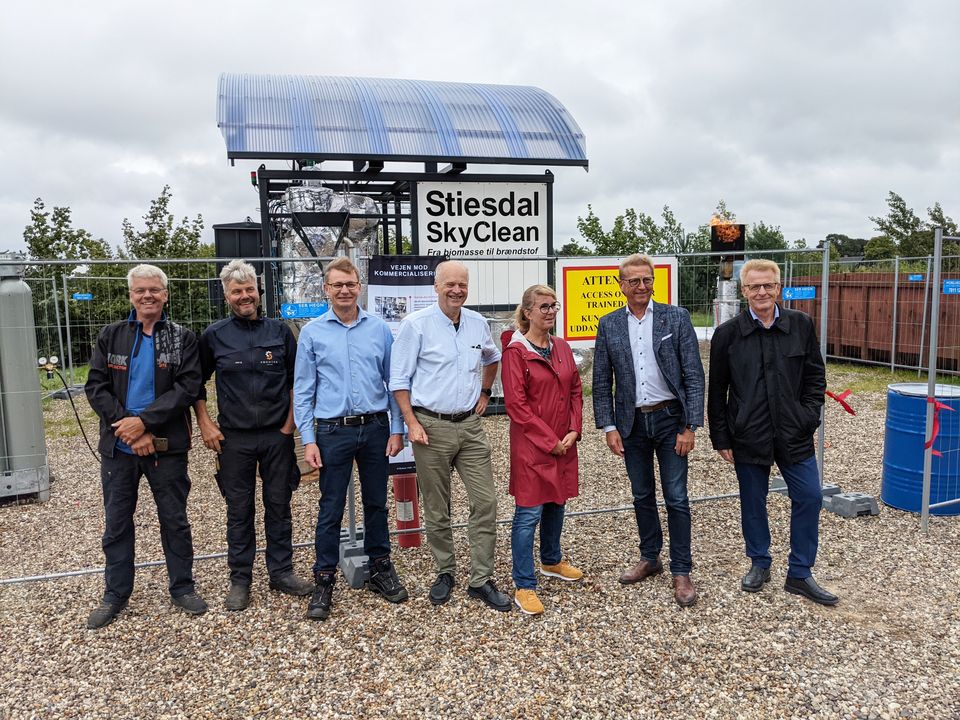
Taken shortly after the inauguration by mayor Peter Sørensen, Horsens Kommune. From the left: Torben Bilstrup, SmedTek, Jan Bilstrup, SmedTek, Peder Riis Nickelsen, CEO, Stiesdal Fuel Technologies, Henrik Stiesdal, CEO, Stiesdal A/S, Kathrine Olldag, MP, R, Asger Christensen, MEP, V, Peter Sørensen (S), mayor, Horsens Kommune.
SkyClean is a game changer for agriculture
Experts from the Technical University of Denmark and Aarhus University have estimated that agriculture can reduce its greenhouse gas emissions by 50 percent using the SkyClean technology.
How SkyClean works
The core of SkyClean is a pyrolysis process in which organic waste from agriculture and forestry is converted into biochar, gas and oil by heating to a high temperature without the presence of oxygen. Dry plant material typically contains approx. 50% carbon that the plants have extracted from the atmosphere in the form of CO₂.
In the pyrolysis process, half of the carbon in the waste is converted to biochar, while the other half becomes oil and gas. Biochar is a stable material that only decomposes very slowly, and the half of the carbon that becomes biochar is thus effectively removed from the atmosphere. The half of the carbon that does not turn into biochar comes out of the pyrolysis process as gas and oil.
The gas can be used as fuel in the heat supply and in industry, and the oil can be refined into fuel for the transport sector – including aircraft.

For more information
Please reach out to Kristian Strøbech
Head of Communications Stiesdal Group